


Today we’d like to introduce you to John Henry Clark.
Hi John Henry, we’d love for you to start by introducing yourself.
I was born and raised in Houston and moved to central Texas in 1989. I have been a journalist for more than 30 years, working for various newspapers across Texas and now working for myself as a freelancer. At one time, I worked as a public school teacher and that gave me the time during summer vacation to write a book, and so my first publication, “Finding God in Texas.”
It was a proud moment seeing my book on Amazon, but not long after that, something even better happened.
I answered an ad or something for a proofreader for a small publishing company and I got the gig. I told them about my book and they said they’d like to take a look at it. Long story short, they liked the book but not the cover or the title, so they agreed to publish it if they could create a new cover and title it, “Finding God: An Exploration of Spirituality Diversity in America’s Heartland..”
I had another book in the works after my trek along with 500-mile Camino de Santiago pilgrimage in Spain, and they took a look and agreed to publish that one, too.
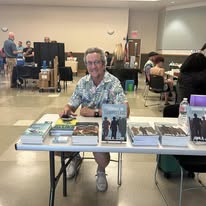
So began my author career, which now is up to 22 published books.
We all face challenges, but looking back would you describe it as a relatively smooth road?
In May 2020, I started working for myself as a freelance journalist and things were going great. Then in April 2023, I got a phone call from a doctor telling me the results of a biopsy on my leg showed cancer.
Life changed forever in that moment.
As I sat in my car in bumper-to-bumper traffic that afternoon, listening to that doctor, I suddenly felt like a tremendous outcast. Like I was defective. There was something wrong with me and I no longer belonged in the world with “normal” people.
Today, I have been cancer-free for nearly 24 months now and I’m still working as a freelancer. I started keeping a journal after my diagnosis and that turned into another book released in January 2025, “Cancer Diaries.”
In this book, I talk in detail about everything that happened to me, and especially what I refer to as the emotional “rollercoaster ride” I went through entering the medical system in hopes of providing the information that I lacked and thereby making their journey a little less stressful. The book is also intended for anyone who knows and loves someone facing a cancer diagnosis by giving them the same information and letting them know it is OK to reach out and offer support in one of life’s most difficult situations.
It is my hope that lots and lots of people who need it find “Cancer Diaries” and it gives them a little reassurance and hope.
Thanks for sharing that. So, maybe next you can tell us a bit more about your work?
I specialize now in feature writing for various central Texas newspapers., which I enjoy very much. Writing truly feeds my soul. I could sit at my laptop pretty much 24 hours a day and be happy.
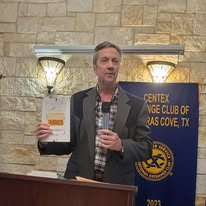
Back in 1992, I won a first-place award from Associated Press for my coverage of the Luby’s Cafeteria Massacre in Killeen, Texas. Since then, I’ve won several other journalism awards, including one for column writing from the South Texas Press Association.
I am a wordsmith but what separates me from others is my ability to conduct an outstanding interview. I don’t remember how or where I acquired this skill, but it has pretty much always been there. I will never forget standing in the newsroom late one night talking with some colleagues, and my managing editor said, “I don’t know how you get people to say the things they do,.”
Basically, I’m a good listener. Like I said, I don’t remember how I learned interviewing skills, but the most important thing about interviewing someone is to listen carefully. The mistake interviewers make is asking a question and then thinking about their next question as the interviewee is answering the first question.
You never know when something completely unexpected is going to happen, and if you’re not paying attention, you could miss it. For example:
I was interviewing a guy one time about his massive comic book collection. He was going on and on about his comics and his childhood and such, when he casually mentions, “And when I was 10 years old, I saw my stepfather beat my mother to death.”
He continued talking and I said, “Wait a minute; wait a minute,” and we went back and talked about that life-changing tragedy some more and it became a significant part of the story that appeared in the newspaper. If I had been focused on my next question, I could have missed what I refer to as a “cha-ching moment” that turned a cute but not-real-exciting story into something far more interesting.
It is OK, of course, to prepare for an interview. Do some research on the subject, have a list of questions to refer to, but don’t forget to listen carefully to everything that is said. You never know when something golden is going to happen …
Can you tell us more about what you were like growing up?
Growing up, I was a pretty intense kid. The oldest of three and always trying to make my father proud. Trying is the key word here.
I played sports all my life and was really good at baseball, football, basketball, track. Unfortunately, I am a perfectionist and never learned to accept losing. I’ve always been an all-or-nothing guy and in sports, there was first place and a whole bunch of last places. No in-between.
My dad and I had a falling out beginning when I was 12 years old that percolated over the next two or three years and by the time I was a sophomore in high school, I was quitting all sports, one by one.
That was always a major regret over the years until I discovered pole vaulting the summer I turned 60 years old. 60 years old?
There is something called USA Track and Field Masters for people 35 and older, and a childhood friend was a world Masters champion in pole vault. I saw something about that on Facebook and messaged the guy, who is four years older than me, so I knew about him when we were growing up, but we were not friends. I knew his younger brother and sister, and Bubba was one of those “famous” kids in high school that everyone knew about.
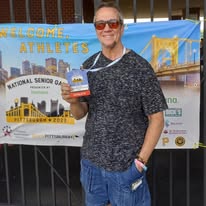
Long story short, Bubba started teaching me to pole vault every Sunday morning for a year and got good enough to rank #17 in the country and qualify three times for the National Senior Games.
More importantly, I was an athlete again, which was something I had been missing for 45 years. I met athletes and made new friends from all over the world and filled a hole that had been there for a long, long time.
Of course, I wrote a book about my pole vaulting journey, “Finally Fit: It’s Never Too Late to Achieve a Dream.”
Contact Info:
- Website: https://www.johnhenryiii.com/
- Facebook: https://www.facebook.com/groups/1158103732611078