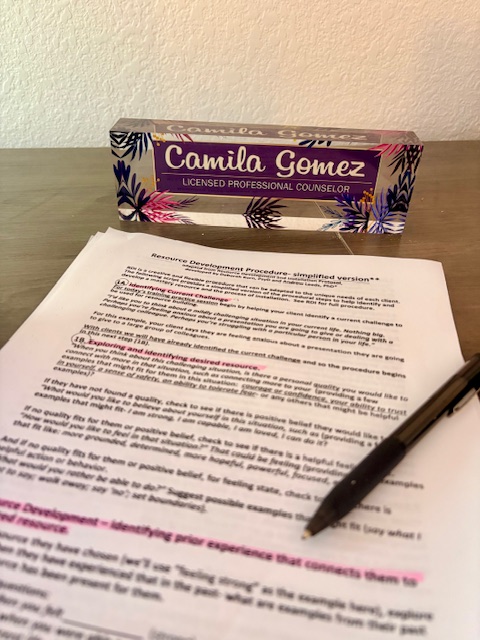




Today we’d like to introduce you to Camila Gomez.
Hi Camila, it’s an honor to have you on the platform. Thanks for taking the time to share your story with us – to start maybe you can share some of your backstory with our readers?
I knew I wanted to be a therapist at age 14 or 15, as this was when I had my first therapy experience. It was truly magical to me. I think at the time I had a lot to say and didn’t know it. The way words would fall out of my mouth, reflecting thoughts and feelings that were brand new to me astounded me, That feeling never left me.
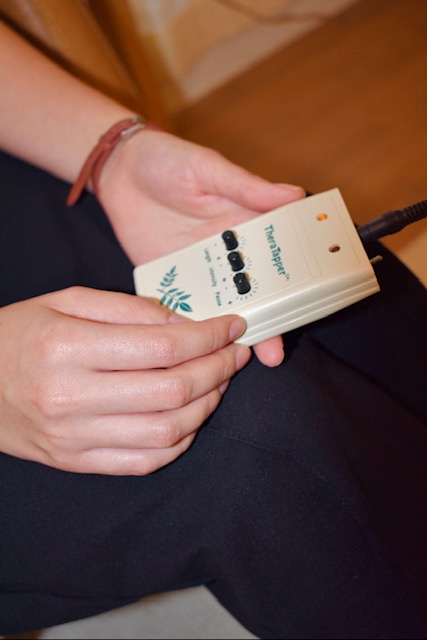
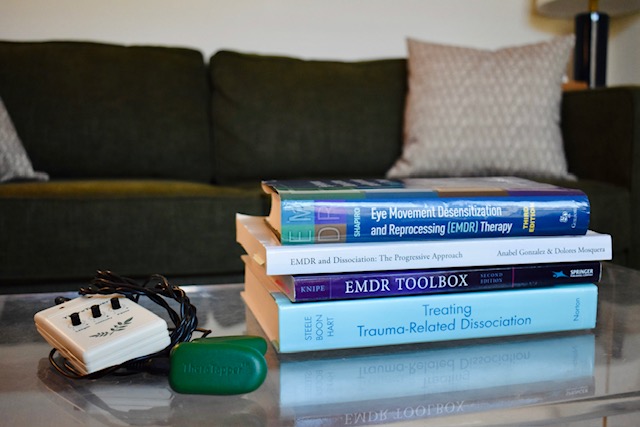
My career started in a psychiatric inpatient unit, where I worked as a mental health technician. I was exposed to a very wide range of issues, populations, ages, and clinical presentations, which probably increased my tolerance to high acuity cases.. I then continued to get my Masters in Clinical Mental Health Counseling, while continuing to work in various mental health roles, and while progressing in my own therapy. It was here that I was introduced to EMDR. EMDR was instantly fascinating to me. It was so novel and exciting, seemingly out of a science-fiction movie. I was surprised at how quickly it helped me find relief from past experiences. So, when I came across an opportunity to get trained in this modality about 2 years later, I instantly took it.
As I completed my EMDR training and began to use it with my clients, I began to realize a problem: I could not use the basic protocol that I was trained on with most of my trauma clients because most of my clients had complex trauma and needed additional interventions. So, I sought out additional training, which meant taking a deep dive into the world of dissociation, parts work, polyvagal theory, and progressive approaches in therapy, and I haven’t stopped learning since.
Can you talk to us a bit about the challenges and lessons you’ve learned along the way. Looking back would you say it’s been easy or smooth in retrospect?
One of the biggest challenges has been learning how to proceed through uncertainty.
I think many of us get into this profession because we genuinely want to help others and our worst fear is causing harm. Though caution is important, it may also be true that there are moments where we may hold back so much, that we do not offer the inner resources we already possess.
In the world of complex trauma, there is always more to learn, and we, as therapists, cannot wait to learn everything to begin treating clients. Otherwise, we would be committing a huge disservice to our clients who do not have extra time to wait.
This means that we must be brave in the therapy room and dare to try new things, collaborate with clients, experiment with different approaches and combinations, go “off script,” and be a little more curious and human. I have gained a lot of relief in learning that I do not have to know the answer to everything up front, and that I can still do a lot of good as I figure it out along the way and remain committed to the process. As a relational therapist, I find that this is a more congruent and honest way to practice as well.
Alright, so let’s switch gears a bit and talk business. What should we know?
I am a counselor specializing in relational and complex trauma (including with dissociation). I primarily use EMDR, attachment theory, and parts work to help clients understand the impact of early relational wounds and process traumatic experiences safely. My goal is to support a deeper healing process that will positively influence my clients’ sense of self, relationships, and emotional well-being, and even provide somatic relief.
What I tell clients is this: Sometimes we get stuck in repeating emotional or relational patterns despite self-awareness and effort. We may struggle with closeness, trust, or emotional safety, and shut down, people-please, or feel overwhelmed when an old wound is activated. Some of us have a history of trauma or attachment injuries, sometimes complex, and/or with dissociation, that makes everything more complicated. This can lead to a place of feeling lost, hopeless, or deeply misunderstood.
I am a steady and dependable companion for people in these situations. I help others heal from past harm and work with them to create corrective future experiences.
I also have had the great honor of mentoring other therapists early in their career, and I have been providing consultation services for other clinicians that would like to learn more about complex trauma and/or dissociation to help their clients.
Finally, I have to mention that as a Mexican-American bilingual therapist with significant personal and professional experience with marginalized communities, my work with immigrants, under-resourced populations, and those with bicultural identities has been very meaningful to me.
Where we are in life is often partly because of others. Who/what else deserves credit for how your story turned out?
My mentor, Christine Molina, who was the person that is responsible for my entry into the field of complex trauma and dissociation.
My friend and fellow counselor, Brooke Brockman, who generously helped me start my business and allowed me to follow in her footsteps.
So may other colleagues, friends, and family have cheered me on, every step of the way. These people have helped me with the ins and outs of my practice, in both big and small ways, including helping me move into my office space, taking pictures for me, gifting me items for therapy, volunteering as my “practice clients” in the early stages of my career, and more. I would not be where I am without them.
Contact Info: