



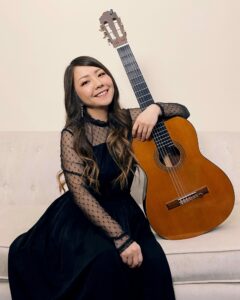
Today we’d like to introduce you to Nanae Fujiwara.
Hi Nanae, so excited to have you with us today. What can you tell us about your story?
Oh gosh, where do I start…
I’ve always been fascinated with music. Currently, I teach classical guitar at several schools in the Chicago Area while performing and sharing my music on social media…
Music was my favorite class in elementary school. I remember when my fifth grade music teacher introduced us to Mariah Carey and we sang her song “Hero”. The words resonated with me –I remember feeling strong emotions and getting goosebumps hearing her voice!
I continued to develop a love for singing through Disney songs. Then, when I was 15, I got into playing acoustic guitar so that I could accompany myself singing. That was the beginning of my guitar journey.
I taught myself how to play guitar and started learning basic chords. At the time, there was no YouTube so I bought a book and tried to learn from it. As a result of practicing 6 hours a day, I had mastered a whole song in just one week! I quickly realized that I had a talent for playing music and I started writing my own songs. I considered myself a singer-songwriter and I knew that’s what I wanted to do for my career.
I wasn’t planning on going to college, but I didn’t feel ready to go out into the world and start working full time while pursuing my singer-songwriter career, so I decided to go to community college to get a general degree. During that time, my mother was taking classical guitar lessons at the same college I attended. I went to her first recital and I realized what she was doing: She was playing classical music. Before that, I never knew that classical music could be played on guitar.
I became very interested in learning about the classical guitar and its repertoire. This was a challenge because I had never learned how to read music. Reading music and understanding music theory was something that terrified me because I was afraid of failing. But I thought to myself, “how can you be a musician and not know anything about music?’ I had to overcome my fears or I would regret it forever.
My mother’s teacher at Harper College, Steve Vazquez (who later also became my teacher) was very encouraging and such a wonderful teacher that I quickly fell in love with the art of classical guitar and practicing. With his guidance, I became proficient enough to go through an audition for an undergraduate music program. I got into several schools and ultimately decided to pursue my Bachelor’s in Music at Northeastern Illinois University…
Afterwards, I went to study guitar performance in Spain. I got my master’s degree from the University of Alicante and returned to Chicago in 2017. Since then, I’ve been teaching full-time and performing concerts. As for my singer-songwriter career… that never really took off. I’m still trying to figure out how I can combine my love for singing and classical guitar but I haven’t succeeded in doing so yet.
We all face challenges, but looking back would you describe it as a relatively smooth road?
I started very late. I mean, have you ever heard of a professional classical musician who started playing and learning to read music at the age of 20? I sure haven’t! Most professional classical musicians start learning their instruments between the ages of 5-8, so I had more than ten years of catching up to do! I spent 6-8 hours every single day practicing guitar, and sometimes that wasn’t enough. There were other limitations too. When you start at a later age, your finger dexterity and flexibility is also diminished, which means some things are going to be physically challenging or impossible all together. Therefore, it’s important to have reasonable expectations for yourself.
Another obstacle I faced was my hand size and height. Guitar is a one size fits all instrument… but it really isn’t. I am very petite, I’m 4’11,” so my hands are smaller than most people. This was a big challenge and it took me a long time to figure out how to work around it. It’s funny because sometimes when I’m carrying my guitar on my back on the street, people stop me and ask if it’s a cello because I’m so short and the guitar looks so huge on me. Right now, I have a guitar made by local luthier Richard Brune that is 0.4 inches shorter than the standard size, and that makes a huge difference!
Can you tell our readers more about what you do and what you think sets you apart from others?
I specialize in performing and teaching classical guitar. I teach in person and online so I have a lot of students from all over the world as well as locally.
Classical music is an art form that is highly technical, and we are merely a vessel for the composer. We have to interpret note for note exactly what the composer wrote. There is no improvising involved so it can be difficult to stand out amongst other musicians, as we could all end up sounding the same. We each have to find our unique sound and voice through our instruments.
Singing was my musical starting point. Therefore, when I play guitar, it sets me apart from other classical guitarists because most other classical guitarists can’t sing. When I play, I’m actually singing the music internally and it’s not just the fingers moving and playing the notes. When I make music, I’m always thinking vocally about how to play per note and phrase, making my interpretation of the music more personal and emotional. Even though classical guitar has no words, it’s as if I’m singing through my guitar.
Some people focus on technique, playing as fast as possible, or trying to impress people with their skills, but I focus on expression and connecting with people.
What matters most to you?
I value the connection that I have with people through music. Since I started classical guitar late, at the age of 20 (most professional classical musicians start between the age of 5-8), I can relate to people struggling to play or read music. I want people to feel like they can start at any age and have a meaningful relationship with classical music.
I also believe that classical musicians are like historians. Our job is to share the music with the public and inform them of the music from many centuries ago. It’s our job to keep the music alive and pass it down to the next generation.
Contact Info:
- Email: nanaeguitar@gmail.com
- Website: www.nanaeguitar.com
- Instagram: instagram.com/nanaeguitar
- Facebook: Facebook.com/nanaeguitar
- Twitter: twitter.com/nanaeguitar
- Youtube: YouTube.com/c/nanaeguitar