


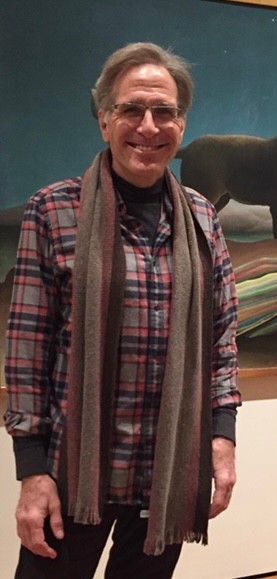
 Today we’d like to introduce you to Peter Nickel.
Hi Peter, so excited to have you with us today. What can you tell us about your story?
Drawing is what I do, and I love drawing my images on the very unique surface of the lithographic limestone. I have always loved to do drawings, even more than painting. It always seemed like it was an immediate and intimate way to get images and ideas out there. Not that some of these ideas weren’t developed in greater depth later in different mediums. But always a drawing first!
Early on, I was attracted to the tonal qualities of papers and pencils and charcoal, and loved developing rich dark surfaces on fine textured papers.
But drawing on the polished surface of a limestone is like nothing else. Why draw on a stone?
It’s all part of a traditional printmaking process. Historically, stone lithography is the basis of almost all the printing processes that exist today. It was invented in the late 1700’s and flourished for over a century. But artists and art publishers have kept this older tradition alive.
How does one get a print of the image that is drawn on the stone? It works on the principle that water and grease don’t mix. The area of the stone that is blank(not drawn with the greasy material) is treated chemically to accept water only. The areas that are drawn remain greasy. So when the stone is dampened and rolled over with a greasy ink roller, the ink only sticks in the spots where the artist has drawn, Sounds rudimentary, but the amount of detail possible is amazing.
I first learned of this process in California, and intrigued by the mystery of it, followed a mentor to Texas to learn more.
That was over 30 years ago.
Can you talk to us a bit about the challenges and lessons you’ve learned along the way. Looking back, would you say it’s been easy or smooth in retrospect?
There have been both personal and professional challenges along the way. As soon as I received my Master’s degree from the University of Texas, I was able to go directly into teaching the craft. That was the incentive- to stay for many years and develop my career and family.
The sudden death of my wife left me grief stricken and the focus became my four-year-old son. I had to find a balance between teaching, my art career, and being a single parent. I was a successful gallery artist, but this proved too demanding. It was as if I was working too hard to do less!
The personal tragedy led me to take control over the forces controlling my life. It forced me to re-assess the way my life was organized, I and made changes that enabled me to have Parallel careers in a self-run business and art.
I am able to explore my creative topics free from academic and retail pressures.
I can be free to explore new mediums as well. I am free to play!
Thanks – so what else should our readers know about your work and what you’re currently focused on?
As I mentioned, I am trained as a printmaker/teacher. I guess if I had to have a title, I would call myself an Artist/Lithographer. I am an artist first., but I also love doing lithographs.
It is a rare thing that these two roles can be combined well. A printmaker usually has a certain personality that is adaptable and is able to work well with other artists. Usually, printmakers work in collaboration with artists in publication houses to produce work in a community effort.
I did such projects as an adjunct at the University of Texas. Lately, I have worked with the folks at Flatbed Press here in Austin to help produce work for other artists.
Flatbed Press is where I produce my work as well.
One of the reasons I use their facilities is that they have one of the largest lithographic limestones in Texas. It allows me to work on a scale larger than I ever have before.
So, some of these images are being exhibited in exhibitions across the country, as well as here in Texas!
Before we go, is there anything else you can share with us?
I would like to add that one must be self aware in the pursuit of a career such as this. It is a continuing journey of self-discovery and is always shifting. A spiritual foundation of self-discovery is key, and is the key that opens a door to a world I would ever imagine for myself, and is far grander than anything I could invent on my own
Pricing:
- Paintings $ 3000-$20,000
- Prints $ 800 -$ 3,000
Contact Info:
- Website: www.peternickel.net
- Instagram: onenickel2
- Facebook: peter neal nickel