


Today we’d like to introduce you to Elizabeth Minger.
Hi Elizabeth, thanks for sharing your story with us. To start, maybe you can tell our readers some of your backstory.
Growing up, I always knew I wanted to help others. As I got older, I explored different helping professions, unsure of exactly where my future would lead. Then, during an adolescent psychology class, I was introduced to counseling, play therapy, and expressive arts, and I was hooked! I was thrilled to discover a career that combined so many of the things I loved.
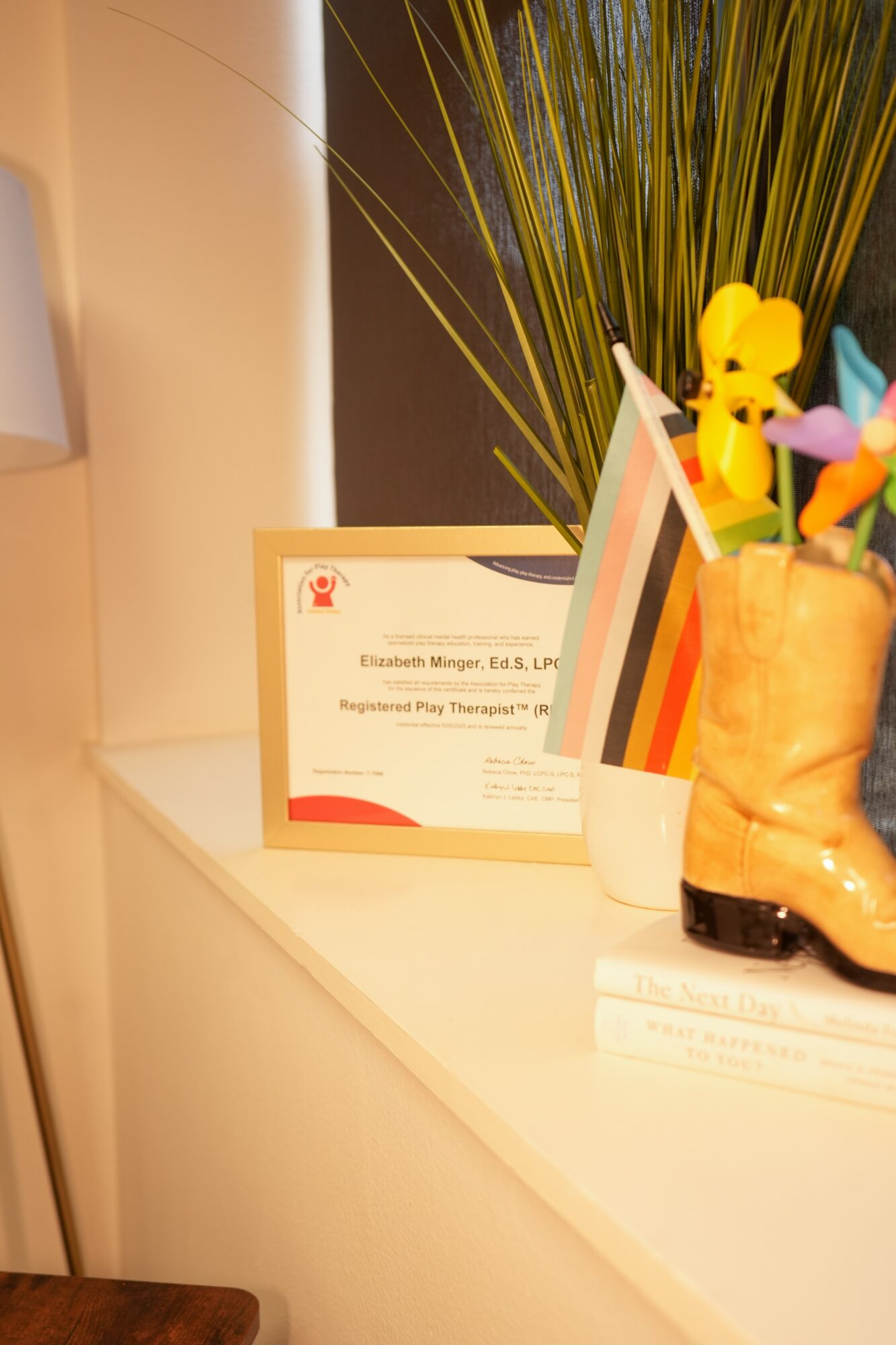
I earned my bachelor’s degree in Psychology from Texas Tech University and went on to complete my Master’s in Clinical Mental Health Counseling and a Graduate Certificate in Play Therapy from Arkansas State University. I am a Licensed Professional Counselor in the state of Texas, and I am a Registered Play Therapist™.
For the past four years, I have worked as a School Based Therapist while also owning a private counseling practice. Over the past year, I have shifted my focus from seeing clients privately to leading trainings and workshops, facilitating parenting groups, and providing consultation to other mental health professionals. I absolutely love this work and am passionate about sharing my love of play therapy and expressive arts with other providers.
As a School Based Therapist, I am also incredibly passionate about school based mental health. Schools are often where children spend most of their time, so bringing mental health support into schools can help reduce barriers and connect students and families with support earlier. I believe prevention and early intervention are incredibly important, and I love finding ways to make mental health support feel approachable rather than intimidating.
Looking toward the future, my goal is to create a holistic therapy practice where families can access a variety of services, including mental health counseling, occupational therapy, physical therapy, speech therapy, and medication management, all under one roof. I would love to create a space where families can receive the comprehensive care they need in one welcoming and supportive environment.
Would you say it’s been a smooth road, and if not what are some of the biggest challenges you’ve faced along the way?
It has definitely not been a smooth road! But I have learned that the things that are worth doing are not always easy.
Working in mental health is such a complex career. There are incredible moments when you get to watch a client achieve their goals and experience growth, but there is also a heaviness that comes with walking alongside people through some of the most challenging moments of their lives. The human experience is incredibly complex, and I will never take for granted the trust that clients and their families place in me as I support them on their journeys.
One of the biggest struggles I have experienced throughout my career is imposter syndrome. For therapists, imposter syndrome can look like questioning whether you are experienced enough, knowledgeable enough, or truly equipped to help the people who trust you with their most vulnerable experiences. Even when you have the education, training, and experience to do the work, there can still be moments when you wonder if you are doing enough or if you are really as capable as others believe you are.
I have experienced imposter syndrome throughout my career, and I have learned that it does not mean I am not a good clinician. Instead, it has encouraged me to continue learning, growing, and seeking support. Finding positive mentors and colleagues has been incredibly important in that process. They have helped me learn to trust myself as a provider, recognize my strengths, and understand that being a good clinician does not mean having all the answers. It means being willing to continue learning, asking for help when needed, and showing up authentically for the people I serve.
Thanks – so what else should our readers know about Elizabeth Minger Counseling?
My work is centered around making mental health support more accessible, creative, and meaningful for children, families, and other mental health professionals. I specialize in play therapy, expressive arts, child and adolescent mental health, parent support, and school based mental health services.
One of the things that sets my work apart is my belief that therapy does not have to look the same for everyone. Especially when working with children, traditional talk therapy is not always the most effective way to communicate. Play, creativity, art, movement, and other expressive approaches can give children a developmentally appropriate way to process their experiences and express things they may not yet have the words to explain. As a Registered Play Therapist, I am passionate about helping other clinicians understand the power of these approaches and feel confident incorporating creativity into their own work.
What I am most proud of is the heart behind my work. Whether I am supporting a child, working with a parent, training a therapist, or developing a program, my goal is always to create spaces where people feel safe, understood, and supported. I want my brand to be known for creativity, authenticity, compassion, and making mental health care feel more human.
Are there any important lessons you’ve learned that you can share with us?
I have learned the importance of asking for help. Asking for help used to be a major struggle for me because I felt like I should be able to figure everything out on my own. I have learned that asking for help is not a sign of weakness or inadequacy. In fact, it is an important part of being a strong professional. Reaching out to mentors, colleagues, and other professionals has allowed me to learn, grow, and provide better support to the people I serve.
Another important lesson has been learning how to say no. In a helping profession, it can be easy to want to say yes to everything because you genuinely care about people and want to help. However, I have learned that saying yes to everything can eventually mean saying no to yourself, your well being, or the things that matter most to you. I have learned that it is okay to turn down opportunities that do not align with my values, goals, or capacity. Sometimes the most responsible thing you can do is recognize when your plate is already full and give yourself permission to step back. Learning to set those boundaries has helped me become a better clinician, professional, and person. I have realized that I can care deeply about others while still making space to care for myself.
Contact Info: