


Today we’d like to introduce you to Iana Witham.
Hi Iana, we’re thrilled to have a chance to learn your story today. So, before we get into specifics, maybe you can briefly walk us through how you got to where you are today?
Both of my parents were artists and they nurtured my creativity from the beginning. In the early 80s, my mother was a receptionist at a high-end Vidal Sassoon salon in Chicago. Although she didn’t have formal training, she picked up the basics of hair color. She taught me how to bleach my own hair when I was about 12 years old. I began to dye my friends’ hair at 13 or 14 and was a full-blown DIY expert in high school, as most of my friends were punks. I even had a DIY hair column with my best friend; she did cuts, I did color.
My mother said to me, “Enjoy it while you can because when you leave school, you’ll have to have normal hair to get a real job.”
I thought, “why, though?”
At 18, I left Austin for art school, specifically the School of the Art Institute of Chicago, and then dropped out after a year due to unforeseen medical hardships within my family. I spent a couple of years doing “whatever” jobs, eventually moving back to Austin and working as a waitress in a strip club. It was certainly interesting but not fulfilling, and I quit on the spot after they would not accept a sick note from my doctor. That was the push I needed to pick a direction and go to beauty school in 2007 at age 22.
My beauty school was not fancy, but it was decent. I cherish my experience there as we were mainly servicing the African American community in the surrounding neighborhood. It taught me more about kinky and curly textured hair than the beauty textbook did. The education is very segregated and I’ve vocalized my criticism of that ever since. I also did a lot of quinceañera hair and pedicures on the elderly.
I graduated, immediately moved to the UK and did styling for photoshoots there. But the financial crisis of 2008 took a toll and I could not find steady work as a newcomer with no reputation. So eventually, I moved back to Austin and settled down at a hip boutique salon on the Eastside called Hearts & Robots. I loved it there so much, and I became the resident fantasy, color specialist. I worked there for seven years until it closed in 2017.
I had two months to figure out where I was going to work in January of 2018. I had heard about a new concept of salon suites and it seemed perfect. For me, it is very difficult to find a perfect fit in a traditional salon because even if I get along with the owner, I have to work with everybody; my clientele has to feel comfortable with everybody and their clients, too. It’s like adopting an entire family, including cousins. A private space for me and my clients is so valuable because by now, I have a solid gender-nonconforming demographic and creating a welcoming, safe environment for them (and my otherwise alternative clientele) is my top priority.
January 8th, 2018, I started my own salon suite for people who were like me, who didn’t feel comfortable or listened to in traditional salons. I was called a “freak” in middle school for dying my hair and many of my clients already called my work their “freak flag” – so the salon practically named itself.
I certainly did not plan to have my own salon by now, but I am grateful to have (once again) been pushed by circumstances beyond my control and propelled in a better direction. I opened my salon ready to shake up the industry and in 2021, my core values are more integral to running my business than ever before.
Can you talk to us a bit about the challenges and lessons you’ve learned along the way. Looking back would you say it’s been easy or smooth in retrospect?
Paying for school and making enough money for booth rent when I was first starting out is a struggle for any new stylist. This industry spends a lot of money on expenses, the bare minimum being: chemicals, tools, and commercial rent. Even after 13 years of professional experience, I occasionally still have to explain this to people who want me to justify my pricing, so that struggle continues.
In Austin, finding solid long-term commercial real estate is a struggle. My last salon closed simply because our rent (and prices) would have tripled overnight and, being our third location, our owner didn’t have the energy to move shop yet again. And now, even with the reasonable rent of a salon suite, most of my income goes straight back into commercial rent. A lot of my social circle, and therefore clientele, are in the service industry so I am constantly towing that line of making money myself and being affordable for my main demographic.
For me, it is very difficult to find a perfect fit in a traditional salon because even if I get along with the owner, I have to work with everybody, my clientele has to feel comfortable with everybody and their clients, too. It’s like adopting an entire family, including cousins. A private space for me and my clients is so valuable because by now, I have a solid gender-nonconforming demographic and creating a welcoming, safe environment for them (and my otherwise alternative clientele) is my top priority.
I have been around salon drama, and I would like to never experience that again. It isn’t cute, it’s a distraction from my actual work and the clients can always tell when the atmosphere is tense or fake. It’s a huge struggle in our industry and that is why so many of us are in salon suites now.
Another struggle is the erasure of curly textured people (of any ethnicity) from the general Hair culture. This is a huge soapbox for me and I’m currently writing about it for my blog. The long story short – many of us curlies have gone in for a haircut only to have our hair straightened and cut/washed/styled improperly for our natural texture, without even being asked if we wear it straight. Hairdressers are not taught how to cut curly hair in school and many of them don’t take the time to educate themselves on it, so they just give everyone straight hair cuts and it basically ruins our hair. This is something that I am always trying to be vocal about. My hair has only been curly a few years but my last salon owner taught me a lot about having curls.
In the Covid19-era, my entire profession is suddenly a high-risk job. I was forced to shut down from March-May 2020 and during that time, I had a major existential crisis, as I have no other real career skills to fall back on. Hair is my whole life, and if I can’t protect myself from spreading the virus to others, then I can’t continue to work in good conscience. This is why I shut my doors (March 13th, 2020) before it was mandated by TDLR, our state regulation. I’m grateful that our franchise owner did not charge us rent during the mandatory shutdown. In Texas, salons were allowed to open in the first stage of reopening, which did not make any sense, being a high contact job in which it is impossible to social distance. I waited as long as I could to reopen but our rent is deducted weekly, and with unemployment, I could only afford to delay my reopening by a month. So I went back to work in June, anxious about the circumstances but grateful that I already worked alone in a space-separated from other people. Freak flag would not still be open if our rent had not been suspended, and I would have had to start from scratch yet again.
Today, this struggle continues as the mask mandate has been lifted by Texas state, but not the city of Austin. This means local business owners are being put in a position of enforcing CDC guidelines themselves, often at risk of their physical person. In concern for my own health and as many of my clients are immunocompromised, I got vaccinated as soon as possible. I can only control the environment in my little mini salon, but every day I hope I am doing enough to create the safest possible space for people to spend time in my chair. I already have such reverence for the act of getting one’s hair done as a transformational ritual; the additional cleaning only adds to how precious that is.
Can you tell our readers more about what you do and what you think sets you apart from others?
I am a hairdresser, color specialist specializing in fantasy hair and… alchemy, really. Many years ago, a client called me a “hair wizard” and it has been my official title on my business cards ever since. I do curly hair; I do multi-ethnic hair, I do bright colors, I do color corrections, I do weird haircuts. My tagline is “Hair sorcery for the strange & unusual” for a reason. I do the long process, tediously detailed stuff other hairdressers don’t want to or can’t.
My brand is gender-nonconforming, gender-affirming, queer-inclusive, BIPOC inclusive, toxic-free beauty with a dark witchy twist. I myself am a nonbinary, goth, witch, and cosplayer… So a lot of my demographic comes from those communities. I have done a few makeovers on tweens just beginning the journey of self-expression and it makes me so happy. I recently had a nonbinary baby goth in my chair. First, they asked about a framed picture on my wall, “who is that?” and I told them, “That’s David Bowie.” Then they asked about another one. I said, “That’s local drag queen, Louisiana Purchase,” and I showed them some more beautiful looks from Louisiana’s Instagram. They were in awe.
I am crying just retelling this story because that wasn’t around when I was a kid; of course, there were queer people in salons then, but there wasn’t a salon that really welcomed me as a queer, nonbinary, witchy, goth kid who just made art, made costumes and played video games. This is why I do what I do because I’m the salon I wish I had when I first discovered who I was.
Things I am the most proud of… Let me start by prefacing, it has always bothered me that haircuts are traditionally priced differently based on gender, not only because that is very confusing for us nonbinary folks but trans people then have to struggle with what that means for them and if they are going to get hassled. It also bothers me that there is this idea that you can’t have funky hair at an older age and that hairdressers can have an entire career never learning how to treat curly textured hair, which is actually a large percentage of the population. As Iana, hair wizard of Freakflag, my mission is: I just want to know what you want to do with your hair and to make that happen for you, regardless of your age or assigned gender or ethnicity. I want you to feel seen and to feel beautiful according to YOUR own standard of beauty, not mine or anyone else’s. These things are apparently grand revolutionary concepts but they seem basic and fundamental to me, and that is what I’m most proud of.
The above sets me apart from others, too. Additionally, a lot of the hairdressers located here are not from Austin, so I bring a local homegrown Austin flavor to my work. I remember the Austin of the 90s… The Drag, Atomic Cafe, La Zona Rosa, Spiderhouse Liberty Lunch… all of my little punk friends in high school went to (and played shows) at the original Emo’s on 6th and Red River, and the owner’s of Elysium have known me since I was little. I remember seeing funky, junky classic cars and tattooed people everywhere… Austin had the highest number of tattoo shops per capita in the country and I am very protective of maintaining that culture here.
So not only am I a really good hairdresser and an inclusive hairdresser, but I have things to talk about with my clients who are old Austinites, as well as telling Austin’s newer transplants what it used to be like. Another thing that sets me apart from others and circling back to the top… With my lifelong background in witchcraft, I truly consider my job to be transformational magick. Talk to anyone who has had a 5+ hour fantasy hair makeover and you will find I am not wrong. I have turned pitch black hair to glistening silver; I am a literal alchemist.
Where do you see things going in the next 5-10 years?
The shift is already happening. The 2020 incarnation of Black Lives Matter has shed light on the segregation within beauty school education and within the industry in general. Curly hair is trendy now, which is good because more people are learning how to cut curls and style curly hair, both hairdressers and clients alike.
The industry is slowly beginning to shift in terms of getting rid of gendered pricing. It’s easy for people who work in salons with younger owners or independents like me but much harder for those working in big chain salons. Salon suites, mini salons, home salons are becoming more frequent; I’m sure because of covid too. Educators are starting to make classes available online, thanks to the pandemic but also maybe that was already shifting. Hourly pricing for color is what I do and it’s so much easier; I am seeing a lot more people do this moving forward.
The Toxic-Free Beauty movement or Clean Beauty movement has gained a lot of traction in the last decade. It is not just a way to upsell high-dollar retail (although that happens with anything). I have seen the benefits of this first hand. Big brands use garbage ingredients to keep costs low. Garbage ingredients are not only harmful for your body and for the planet, but they give garbage results. Clean beauty costs more because it is always cheaper to make a low-quality product; that’s why there are so many in the drugstore. But you use less of a high-quality product because they are powerful and concentrated, and people are starting to realize that.
Pricing:
- Short haircut $70
- Long haircut $100
- Color services $120 per hour
Contact Info:
- Email: iana@freakflagbyiana.com
- Website: https://www.freakflagbyiana.com/
- Instagram: @freakflagbyiana
- Facebook: https://www.facebook.com/freakflagbyiana
- Yelp: https://www.yelp.com/biz/freakflag-by-iana-austin
- Other: TikTok @freakflagbyiana


 Image Credits
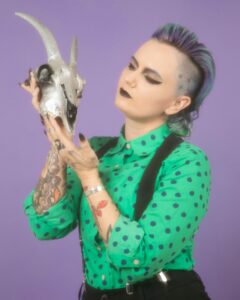
The one portrait of me with the skull is a paid portrait by Jackson Montgomery Schwartz / @jxnart http://www.jxnart.com/.