


Today we’d like to introduce you to Aniruddha Das.
Hi Aniruddha, I’m so excited to have you on the platform. So before we get into questions about your work life, how can you bring our readers up to speed on your story and how you got to where you are today?
This is Aniruddha Das, and I am a scientist by profession. I am currently working as a research scientist in Biology at the University of Texas at Austin. Recently obtained a doctorate degree from Poland and published my scientific work in a reputed scientific journal.
In 2016, I traveled all the way to Germany for the first time outside of my homeland, India. I was very nervous and excited about everything. After working on a short project for a year, moved to Poland, the neighboring country in 2017. This time, it lasted for more than five years. Initially, quite occupied with my work, but later on started exploring life outside the work. Whenever went outside, I experienced many exciting things around me. That actually motivated me to pick up my video camera and start recording every amazing moment as well as clicking photos. First, I shared some of these outdoor photos and videos with my close friends. They were excited and began asking me to share more photos and videos. After that, started creating videos and sharing them on YouTube. Soon realized that many travel vloggers, photographers, and cinematic vloggers are on YouTube, Instagram, and Twitter. Also, people with lesser scope traveling around the world like watching freely available content on the internet. From the beginning, my purpose has been to share content that is accessible to all people and provides entertainment. I was lucky enough, and my career path gave me access to Europe and to visit different places. Considering this priceless opportunity, started making more videos and engaging my free time with nature- or architecture-based photography. Later, started sharing photos on Instagram.
There are many popular YouTubers out there, but the content created by Sam Kolder and Peter McKinnon is incredibly creative, and I closely follow their works. From there, actually took the inspiration to create a cinematic vlog. Of course, my videos are far from their level of creativity, but watching their videos always gives me goosebumps and ideas to create my own story through cinematic video. Importantly, while creating a video, I always try to focus on establishing a story and try to make it visually creative. The Instagram journey started later than my YouTube journey when I reached a hundred subscribers. I started clicking more photos, however never actually thought about investing in gadgets for this. Eventually, I focused on buying a smartphone that might add some clarity to the video and make the photos more attractive and natural without any additional photoshops. I continued doing this as a hobby and love taking it ahead.
Can you talk to us about the challenges and lessons you’ve learned along the way? Looking back, has it been easy or smooth in retrospect?
Working as a researcher in an academic environment is quite challenging when it comes to managing work-life balance. We often need to work overtime to get success in our
experiments and meet important deadlines. Besides bench work, we must also attend weekly meetings, journal clubs, writing and reviewing articles, and other important meetings.
After all these, taking time out for a hobby is often challenging. However, stealing time for oneself is necessary to grow and explore different aspects besides professional life. That
always triggers me to take out time for hobbies and add content to my social media handles. Currently, there is no monetary support to invest in my hobbies, so try to make the best
out of my everyday Google smartphone. Social networking sites are overwhelmed with new posts every second, so to be noticed in the crowd, it’s important to post quality content
as often as possible. I lack that for now and find it challenging to do so. However, I always try to be consistent with my social media posts.
I appreciate you sharing that. What else should we know about what you do?
I am currently working as a Postdoctoral fellow at the University of Texas in Austin. Let me explain my research in a simple context. Imagine our body as a bustling city with many buildings and streets. This city has a special place called the “proteasome.” Think of the proteasome as a kind of recycling center or garbage disposal for the city. Now, in our city (body), many tiny workers called “proteins” do all sorts of important jobs, like building and maintaining things, helping with communication, and even controlling how things work. However, these proteins sometimes become old, damaged, or no longer required. This is where the proteasome comes in. Similar to how we put our garbage in a bin to be removed, cells in our body put these old or unwanted proteins into the proteasome. Proteasomes act as large recycling machinery. It breaks down these proteins into smaller pieces by recycling them into their basic parts. These smaller parts can then create new proteins that our bodies need. So, you can think of the proteasome as a helpful cleanup crew that takes care of the proteins we do not need anymore, so their building blocks can be used to create new and important things for our body. In my current position, I want to understand what regulates proteasome activity, which allows effective protein cleanup inside cells. For that, I am using a single-cell organism called Saccharomyces cerevisiae (yeast), which possesses a nucleus and other membrane-bound organelles like higher organisms. In addition, yeast cells are relatively easy to study and culture under laboratory conditions because they do not require complex media for growth.
Before coming to the USA, I did my doctoral research in a similar field, where I studied how E3 ligase activity modulates its activity. Let’s break down what an E3 ligase is in fundamental terms. Again, imagine you are building a tower out of the building blocks. Each block represents a protein in the body that has a specific function. Now, sometimes you want to change or eliminate a specific block because it is no longer needed or causing problems. Here’s where the E3 ligase comes in. Think of the E3 ligase as a special tool that works like a construction worker with a “remove” button. This construction worker, the E3 ligase, can tag a certain protein block that needs to be removed from the tower. Once the E3 ligase tags the block, it’s like pressing the “remove” button. The E3 ligase helps attach a tiny label to the protein block, saying, “Time to go!” This label signals to another part of the cell, like a cleanup crew, to come and break down that tagged protein block into smaller pieces. Therefore, in simple terms, an E3 ligase is similar to a construction worker with a special tagging tool. It marks specific proteins for cleanup by placing a label on them, and then, the cell’s cleanup crew comes along and takes care of proteins that are no longer needed or cause trouble.
I am always fascinated by how cells regulate diverse and complex processes in a controlled manner. My long-term goal is to carry forward my research in the field of proteasomes and increase my understanding of how unwanted proteins are degraded via the proteasome and how disease conditions or aging negatively impair this process. As, proteasome inhibitors could be potentially used as specific cancer drugs, and many targeted therapeutic modalities depending on the activity of the proteasome, a crucial degradation machinery, this active area of research has many therapeutic implications and has a lot of translational aspects.
We’d love to hear about how you think about risk-taking.
In my career, I have experienced countless ups and downs. From choosing my career path to pursuing my doctoral study in Poland and doing my Postdoctoral study in the USA. I faced many difficulties that have made me feel very disappointed and negative at multiple points in my life. At a moment, I was wondering whether really I could achieve what I wanted. In my family, everyone chooses to be an engineer or a doctor by default. My career choice is unconventional and unappreciated, also because this area is mostly unknown to many, and career paths and end goals are not always very clear. However, since childhood, I have always had an obsession with curiosity and creativity. At a younger age, I was always fascinated by watching how scientists work wearing white lab coats inside a sophisticated research laboratory setting. It used to feel like a dream to me. I only chose to pursue a career in science because I love to explore new things that are yet unknown, always feel excited to do experiments, solve puzzles, and lastly work in an environment that I always dreamed of.
Nevertheless, I must admit that never got good marks, or stood first during my schooling. Only because of my desire and capability to withstand several failures, I am doing what I wish to do. Eventually, my hard work paid off in terms of a doctoral degree in the desired scientific field. After my master’s degree, it really took a while to understand the specific field in which I wanted to pursue my doctoral study, hence working at different research institutes as a junior researcher in diverse research fields helped me. At one point in my life, I had been working for more than six months without any salary or monthly allowance. That was a hard time and every situation was pulling me away from my desire. Before joining as a doctoral researcher in Poland, I wrote almost a hundred emails to scientists and institutes. I got almost ninety-seven percent refusals. However, along the way, I have gone through a lot of rejections in my career trajectory. It is a valuable part of my life because I learned a lot about life and my weaknesses through these painful failures. Whenever I go back to my past, I realize that those difficult times helped me to become a stronger person to face challenges in the future. The excitement of learning new things always cost me a lot in the past, but in the end, it was worth pursuing the hard way.
Contact Info:
- Instagram: instagram.com/aniruddha_photograph
- Linkedin: https://www.linkedin.com/in/das-aniruddha/
- Twitter: https://twitter.com/_AniruddhaD
- Youtube: https://www.youtube.com/@aniruddha_das/videos


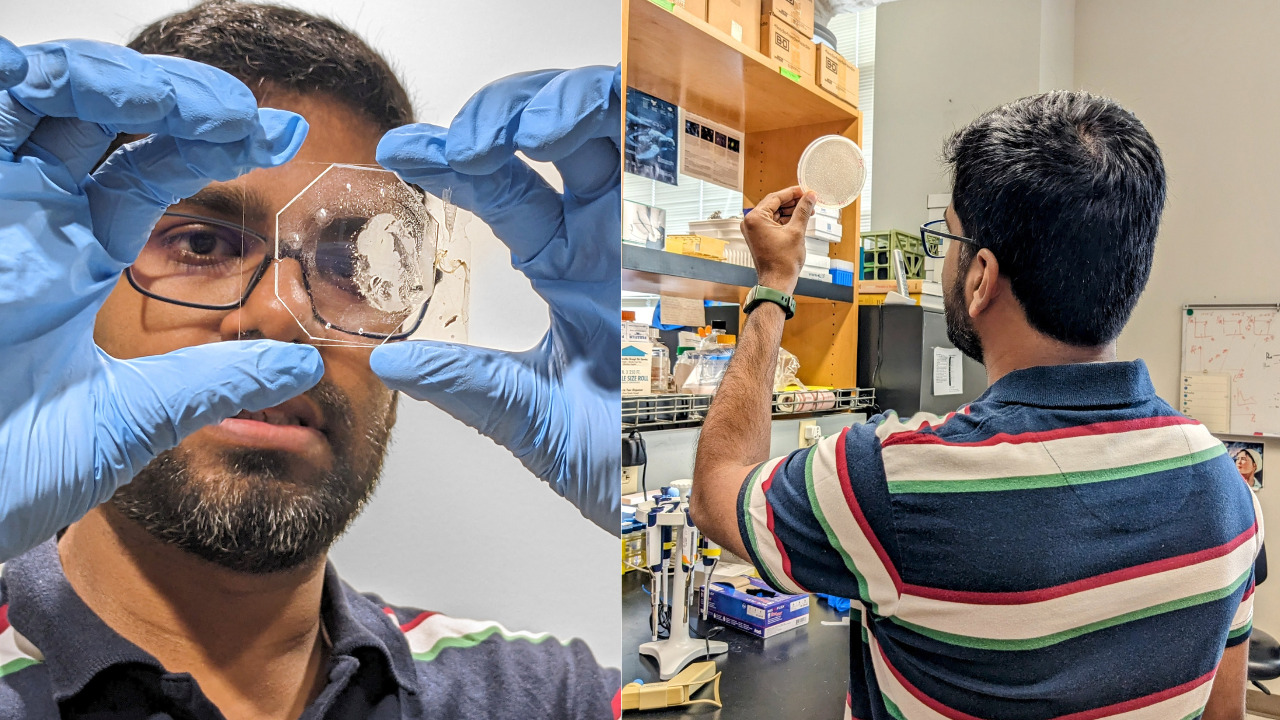
Image Credits
Anastasiia Andrianova, Nilesh Shanmugam
Yuliia Burachok