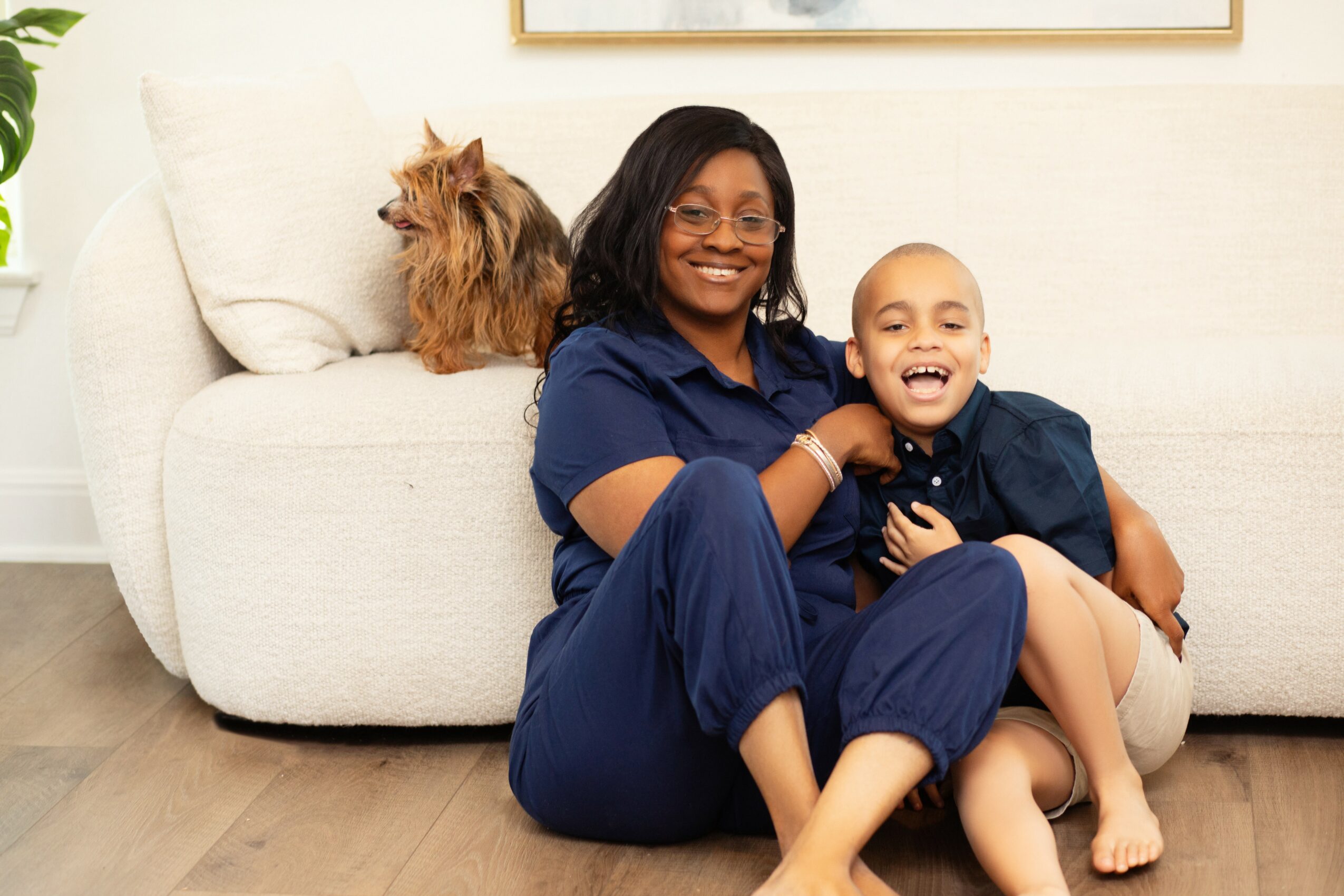

Today we’d like to introduce you to Rebecca Prejean.
Hi Rebecca, so excited to have you with us today. What can you tell us about your story?
My story really begins with my son, Ethan. During my pregnancy, we were told he had hydrocephalus and that he would likely never walk or talk. There’s no way to prepare for news like that. You carry the weight of it quietly, hoping the doctors are wrong while trying to brace yourself for whatever comes next. And in our case, the doctors were wrong. Ethan walked. He talked. And as he grew, he continued to challenge every assumption people made about him.
Later, when he was diagnosed as autistic, it didn’t surprise me, and I think we were more prepared because of everything we had already been through. But with that diagnosis came a different set of challenges: trying to find resources, support, and people who could actually work with him in a way that matched how he learned. It was shocking how hard that was. I kept running into systems that weren’t set up for kids like him—systems that assumed one way of learning, one way of communicating, one way of being.
At the same time, I was working in Learning and Development, training adults in Customer Support. My job was to break down complex processes, teach new skills, and help people succeed in environments that constantly changed. And the more I supported Ethan at home, the more I realized the adults I trained were struggling for a lot of the same reasons Ethan struggled. They needed support that we just weren’t giving on the corporate level.
That realization was a turning point for me. I started to see that so much of what we call “employee performance problems” are actually accessibility and communication problems. People weren’t being set up for success, and once I saw that, I couldn’t unsee it. That’s what ultimately led me to rethink the way I approached training, learning, business, and employee success. It also became the foundation for my company, E.B. Graphics & Consulting.
Today, I create accessible learning experiences, multimedia content, illustrations, videos, eLearning modules, and communication systems that help people actually understand what’s being asked of them. My work is a hyrbid of accessibility, design, learning, and real human behavior, because I spent years watching one little boy show me what clear communication can do when it finally reaches the person on the other side of it.
Can you talk to us a bit about the challenges and lessons you’ve learned along the way. Looking back would you say it’s been easy or smooth in retrospect?
One of the biggest challenges in my life has been trying to balance work and motherhood when neither one came with a predictable routine. Raising a neurodivergent child means the plan you had for the day often isn’t the plan you end up with. Therapy schedules, unexpected school situations, and hard days come up quite a bit. Trying to build a career inside that level of unpredictability forced me to rethink how to manage my time, my energy, and my expectations.
Another challenge came from realizing that a traditional work environment simply didn’t fit the reality of my life. I needed flexibility long before flexibility was something people talked about. There were moments when it felt like I was constantly choosing between being present for my son or being present for my job, and neither option felt sustainable. That tension showed me very quickly that I would need to structure my work differently if I wanted to keep going without burning out.
I also had to navigate a lot on my own. Being the default parent and the decision-maker means you don’t get the luxury of waiting for someone else to figure things out. Whether it was advocating for Ethan at school, adjusting our routines at home, or restructuring how I worked, I had to learn to respond quickly and keep things moving even when I didn’t feel prepared.
What has helped me work through these challenges is learning to adapt in real time. I stopped trying to force my life into a box of what it should be instead of what it actually looked like.
Thanks – so what else should our readers know about E.B. Graphics and Consulting?
Rebecca Prejean is the founder and CEO of E.B. Graphics & Consulting, a multimedia, learning, and accessibility studio specializing in making complex ideas clear, engaging, and inclusive. She blends instructional design, visual communication, and creative strategy to create solutions that help people actually understand the information in front of them.
Her work spans eLearning development, illustrated and animated content, video production, graphics, curriculum design, and accessible digital experiences. Rebecca partners with organizations in education, healthcare, corporate learning, and the nonprofit sector to transform dense or confusing content into materials that are intuitive, visually compelling, and usable for diverse thinkers and learners.
What sets her work apart is her focus on accessibility as a business advantage. She helps clients redesign training, communication, and user experiences so they work for neurodivergent employees, multilingual audiences, and individuals who process information in different ways. Whether she’s building a full-scale training program, redesigning a visual system, or creating interactive multimedia, her approach centers on clarity, structure, and making sure people can actually apply what they learn.
Through E.B. Graphics & Consulting, Rebecca has become a trusted partner for teams who want polished visuals that support performance, reduce confusion, and strengthen the way employees and customers experience their brand.
How do you define success?
For me, success is measured by impact, specifically, whether I’ve helped businesses understand that accessibility isn’t an add-on or a compliance task, but a genuine business advantage. When a leader finally sees how designing for different thinkers improves their revenue, productivity, retention, and customer experience, that’s success. When accessibility becomes part of their standard business practice, not something they remember only when there’s a problem, that’s success.
On a personal level, success is being able to work in a way that aligns with my values. It means building a business that supports my life, not one that requires me to shrink or hide parts of it. It means being able to raise my son, run a company, and use my expertise in accessibility, communication, and multimedia design to change how people think about their workforce.
I don’t define success by perfection or scale. I define it by influence
Contact Info:
- Website: https://www.ebgc.net
- LinkedIn: https://www.linkedin.com/in/rbprejean/