



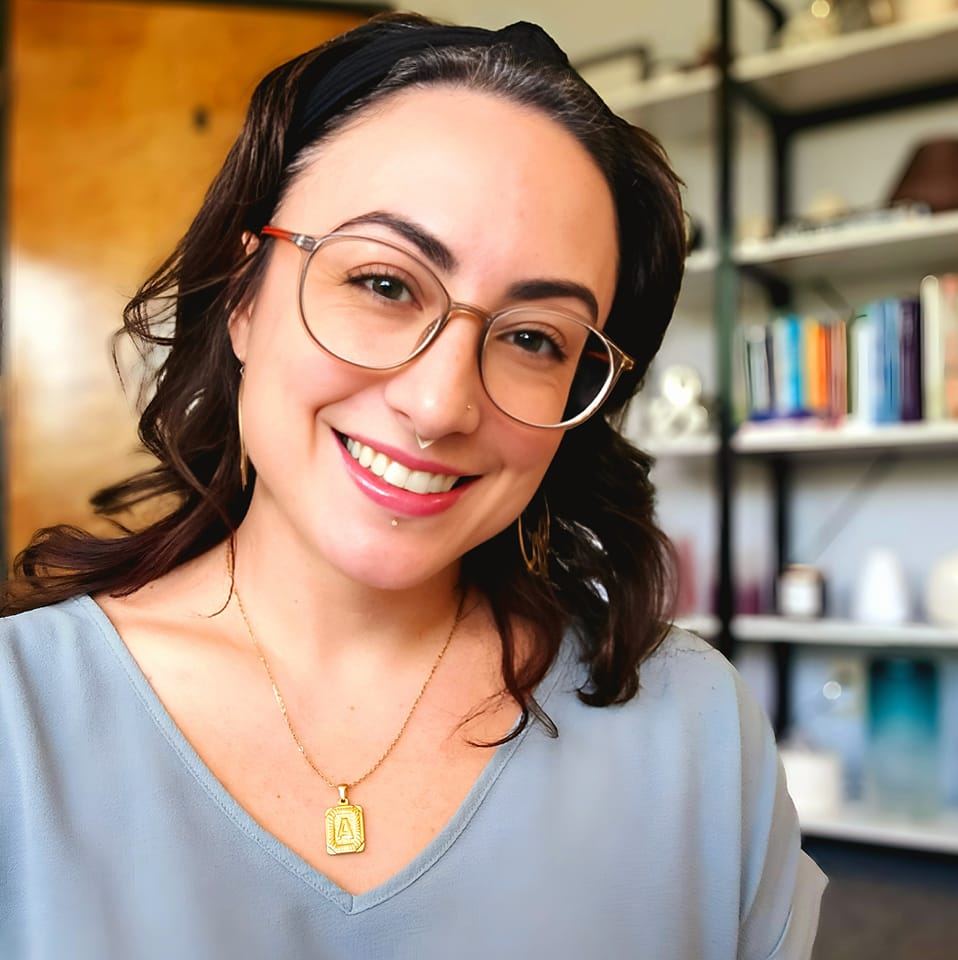
Today we’d like to introduce you to Amanda (Amy) Richardson.
Hi Amanda (Amy), thanks for joining us today. We’d love for you to start by introducing yourself.
I originally went to college to pursue a degree in biochemistry to become an epidemiologist and study infectious diseases, but I had my first depressive episode and flunked out of intro chem. Because I went to a small public high school that did not offer any classes about psychology, I never got to explore that topic even though I was always curious about it. After I failed chem, I took that opportunity to take an intro psych course in second semester of freshman year of college. I took an abnormal psychology course next and fell in love with the subject, and I decided to switch my majors to Psychology and Cognitive Science to pursue clinical work. I have always been fascinated by people, how they work, and how they have developed into the person in front of me, so psychology was a natural progression of that curiosity. I am also a very empathetic person and care deeply about people, so finding a career that enhances these traits within myself and which I am passionate about was a dream come true. While there is nothing wrong with having a job just to pay the bills, I have always been the type of person who has to feel passionate about what they do, whether it’s a career or a hobby or what have you. Since I have also struggled with relational wounding, depression, and neurodivergence, I find that my experiences also allow me to relate uniquely to my clients in many ways.
After undergrad, I completed two Masters degrees in psychology, finishing up with my M.S. in Clinical Mental Health and Rehabilitation Counseling from Thomas University. I started out working in Massachusetts, where I am originally from, doing In-Home Therapy, which is a service providing intensive therapy to at risk youths and their families multiple times a week, and then I moved into crisis work providing assessments and care coordination, and eventually moved here to Texas where I briefly worked with domestic violence survivors with a nonprofit before moving into group private practice.
For a long time I did not want to open my own private practice because I thought it would be too much administrative work outside of the clinical work I want to do, but the financial strain of working for group practices eventually pushed me to look into opening my own practice. Group practices are wonderful for networking, clinical guidance, and referrals, but they also take a significant cut of the profits a therapist brings in, anywhere from 50-70% of the fee of any given session. So this past July, I decided to take the leap and open my own solo private practice!
Can you talk to us a bit about the challenges and lessons you’ve learned along the way. Looking back would you say it’s been easy or smooth in retrospect?
It has definitely not been a smooth road! My first Master’s program did not meet the educational requirements for licensure nor was it accredited and I ended up having to go back for a second Master’s to complete those, so that financial burden ended up being pretty significant. With the time it took to complete two of those degrees, I might as well have just completed a PhD program! Additionally, trying to find decent paying jobs as an Licensed Professional Counselor, Associate (LPC-A), aka a recent post-grad with a license but not a *full* license, is incredibly challenging and disheartening. Many group practices and community mental health companies take advantage of LPC-As being at the bottom of the professional ladder and exploit their labor for their own financial benefit, taking a big chunk of the LPC-A’s revenue from sessions and putting many LPC-As in the position of having to work multiple jobs to make ends meet.
In addition to low paying jobs, the cost of the required licensed supervision for 2-3 years after obtaining the Associate license is exorbitant and exploitative. Unless you can find a supervisor at your place of work for free (and some places do not allow this), the monthly fee for the weekly required supervision is anywhere from $300 to $500 a month. While the benefits of being a part of a group practice or working in community mental health ideally include a steady referral stream, networking, socializing and community, and admin work, I personally don’t think these benefits are enough to warrant the financial exploitation of recent post-grad therapists. I was fortunate enough to find the few well-compensating group practices for LPC-As here in Austin, but even that was still not enough to make a comfortable living. I have heard horror stories about other places in town that heavily take advantage of Associates. Some of these places overburden their Associates, managing to overbook them while undercompensating them, leading to high clinician burnout, poor client care, and unethical actions from both admin staff and therapists themselves to compensate for this imbalance and exploitation. Many private group practices in town are also selling out to big private equity firms that prioritize profit over client care and exacerbate the issues that are already latent within this field.
Thanks for sharing that. So, maybe next you can tell us a bit more about your work?
I am a Licensed Professional Counselor with an M.A. in General Psychology from The New School for Social Research and an M.S. in Clinical Mental Health and Rehabilitation from Thomas University. I specialize in treating trauma in teens and adults at my solo private practice, Body/Mind Harmony Counseling, PLLC. My particular niche within trauma is working with C-PTSD (Complex PTSD) from an attachment and neurobiological lens, with an emphasis on treatment modalities that highlight body-based, experiential, and relational work. Many of my clients have suffered chronic and recurrent physical, sexual, emotional abuse, and/or physical, emotional neglect from caregivers or experiences in their early life, and when there is wounding from a relational place (relationships with other people), that is where healing must go as well. This is why I focus on using the therapeutic relationship and body-based, somatic approaches in my work with individuals. I am trained in Eye-Movement Desensitization and Reprocessing, Internal Family Systems, Somatic Experiencing, and I am a Certified Clinical Trauma Professional, Level II with Janina Fisher. I am also working on completing training in Coherence Therapy at the moment.
My treatment philosophy approaches people with the understanding that their symptoms and struggles make sense as beneficial adaptations to early life experiences, and when those start to cause problems in their adult lives, it simply means we must work toward unlearning and healing those early wounds and traumas and learning new ways to be in the world, and how to hold space for joy and hope as well as remain centered in distress. My education and knowledge on the neurobiology of trauma, interpersonal neurobiology, attachment theory, child development, and polyvagal/nervous system theory gives me unique insight into how human beings function and adapt to the world around them, and how the environment x person relationship is highly reciprocal, giving rise to the person who shows up in my office in the present day. I also believe all humans have the innate ability to psychologically self-heal, and sometimes they just need a nudge in that direction. Everyone makes sense, even if their behavior or thoughts don’t always seem to on the surface. All behavior has a purpose and function, it’s often just about figuring out what that is!
I am also LGBTQIA+, poly/CNM, and kink informed/friendly.
Other than my treatment approach and philosophy, I think what sets me apart from others is the genuine and authentic way I show up with clients in session. I do not believe in being a “blank slate” therapist because my relational orientation has proven to me time and time again that authentic connection between two people in the room can be more healing and life-changing than anything else. Many modalities are effective, but the most important aspect of therapy is always going to be the safety and connection in the relationship between therapist and client. Additionally, I work from a de-pathologizing and anti-oppression lens emphasizing the creation of community, repair in relationships, and encouraging each person to find meaning for themselves outside of what has been socially prescribed to them by capitalism, partiarchy, and the other oppressive systems in our culture.
I am most proud of the recent decision I made to branch out on my own and start my private practice! It was a big leap for me, financially and otherwise, but it is going well so far. I am also incredibly proud of my clients; I am amazed and honored every single day to witness their growth and progress. I may provide the safe space and helpful information, but I am at most a facilitator and guide to their own innate self-healing and fulfillment.
Where do you see things going in the next 5-10 years?
Unfortunately I am concerned about where our industry is heading over the next 5-10 years, partially because of the growing reliance on AI chatbots and partially because of the encroachment of private equity and greedy insurance companies trying to take over group practices and underpay clinicians to absorb them into large corporations. Although I am concerned about how these things will impact clients and therapists alike, I also do have faith that nothing can replace human-to-human relating and healing, and that ultimately this field will survive these challenges as people come to understand that community and in person connection are vital to mental and physical wellbeing.
Pricing:
- Private pay range is between $125 and $200 per hour session
- I do offer limited sliding scale private pay fees as low as $75 per session.
- I currently accept some insurances, primarily UHC, Cigna, and Aetna.
Contact Info: