



Today we’d like to introduce you to Lizzie Wilson.
Hi Lizzie, can you start by introducing yourself? We’d love to learn more about how you got to where you are today.
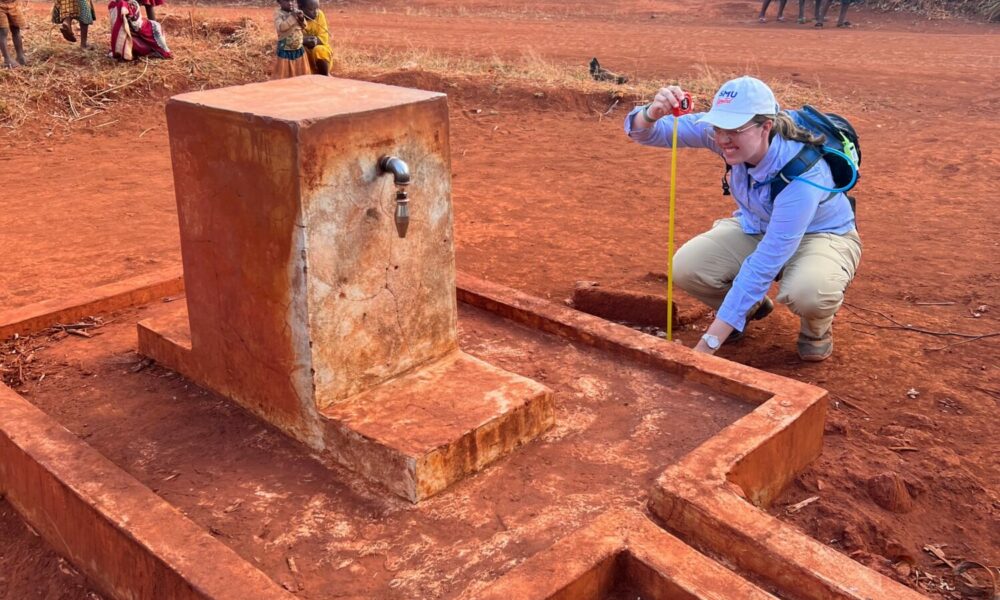
Engineers Without Borders (EWB) was founded in 2002. Many EWB projects are Civil Engineering focused, with a large percentage being water supply, civil works, and sanitation projects. The Greater Austin chapter of EWB was founded in 2009, merging the UT student and Austin Professional Chapter. We are one of three blended chapters out of a total of 274 total chapters within EWB USA. This unique aspect of our chapter has formed connections between professionals and students, for which I am grateful. I studied Environmental Engineering at SMU to give people clean water. I may not be a doctor who treats people who are sick, but in this way, I can help prevent people from getting sick. I joined the EWB chapter at SMU as a freshman. When I moved to Austin, I soon found and joined the Greater Austin chapter of EWB. A lot of my friends and connections have come through EWB. I am getting married in March 2024, and I have volunteered with EWB with 3 of my bridesmaids.
We all face challenges, but looking back, would you describe it as a relatively smooth road?
The road to completing EWB projects can be challenging. For example, when I was with EWB SMU, we were supposed to travel to western Rwanda. However, violence in eastern Congo flared up near our partner community, with shell fragments landing in the backyard of our partner NGO (non-governmental organization). Out of concern for the safety of our volunteers, the trip was postponed to later that year. EWB does a great job protecting our volunteers and suspending travel when deemed unsafe.
Generally, on trips, something goes wrong or at least unexpectedly. For example, in the US, our culture is very timely. If a meeting is set to start at 9, most people arrive by 9, and the session begins. In other cultures, arranging an appointment to start at 9 means people may begin to arrive 2-3 hours later. This can be hard for a project team to anticipate, mainly when it is our first project trip, but our travel team members are generally very adaptable. The global pandemic prevented travel for a couple of years, which delayed our water supply project in Tanzania. I am very proud of our members for transitioning smoothly to meeting virtually and continuing to make as much progress as they could remotely. Even if it isn’t a smooth road, I am always proud of our members for adapting and persevering.
Thanks – so, what else should our readers know about your work and what you’re currently focused on?
I have chosen to dedicate a lot of my life and time to EWB because I believe in its mission and methodology to accomplish that mission. There are a few key aspects to EWB, including an engineered solution for each partner community, a 5% community buy-in, and a minimum of one-year monitoring.
We are not a one size fits all organization. Engineering services can be expensive, so we provide pro bono engineering services to needy communities. Rather than coming into a community, installing a well, and leaving, we engineer a solution specific to each partner community. We make at least one assessment trip to visit the partner community, assess the current need, meet with the community, and gather the data required to design the project. Each of our international projects requires a 5% community buy-in. That 5% cash contribution goes a long way to ensure the longevity of our projects. Sometimes the 5% community cash contribution can be a lot for a community, but this ensures the community wants the proposed project and will care for it in the long term. A different, less expensive solution is offered if a society needs more than 5% community buy-in. The way it was posed to me that helped was it is still a 95% discount.
Finally, all of our international projects have a minimum of a one-year monitoring phase. During this phase, the community cares for the project and has easy access to us if they have questions or notice a problem with the project that needs to be fixed or re-designed. After a year, the project is officially handed off to the community for them to own and care for.
Do you have any advice for those looking to network or find a mentor?
Joining a professional organization and attending meetings has been the most productive way to network. With EWB, most projects meet once a week, which means you generally see the same people every week and can form some genuine relationships. Some of my coworkers and interns have come through connections with EWB. Many professional organizations have student chapters if you are a college student (and if your university doesn’t have one yet, you could start one!). When joining an organization, speaking up at first can sometimes be intimidating, but these organizations want your help and input. On the management side of a volunteer organization, we cannot force a volunteer to do anything, so we often rely on the initiative of volunteers. I tell new members that whatever you put into it, you will get out of it.
Contact Info:
- Website: https://ewbgreateraustin.org/
- Instagram: ewbaustin
- Facebook: https://www.facebook.com/EWBAustin
- Linkedin: https://www.linkedin.com/company/ewbaustin/