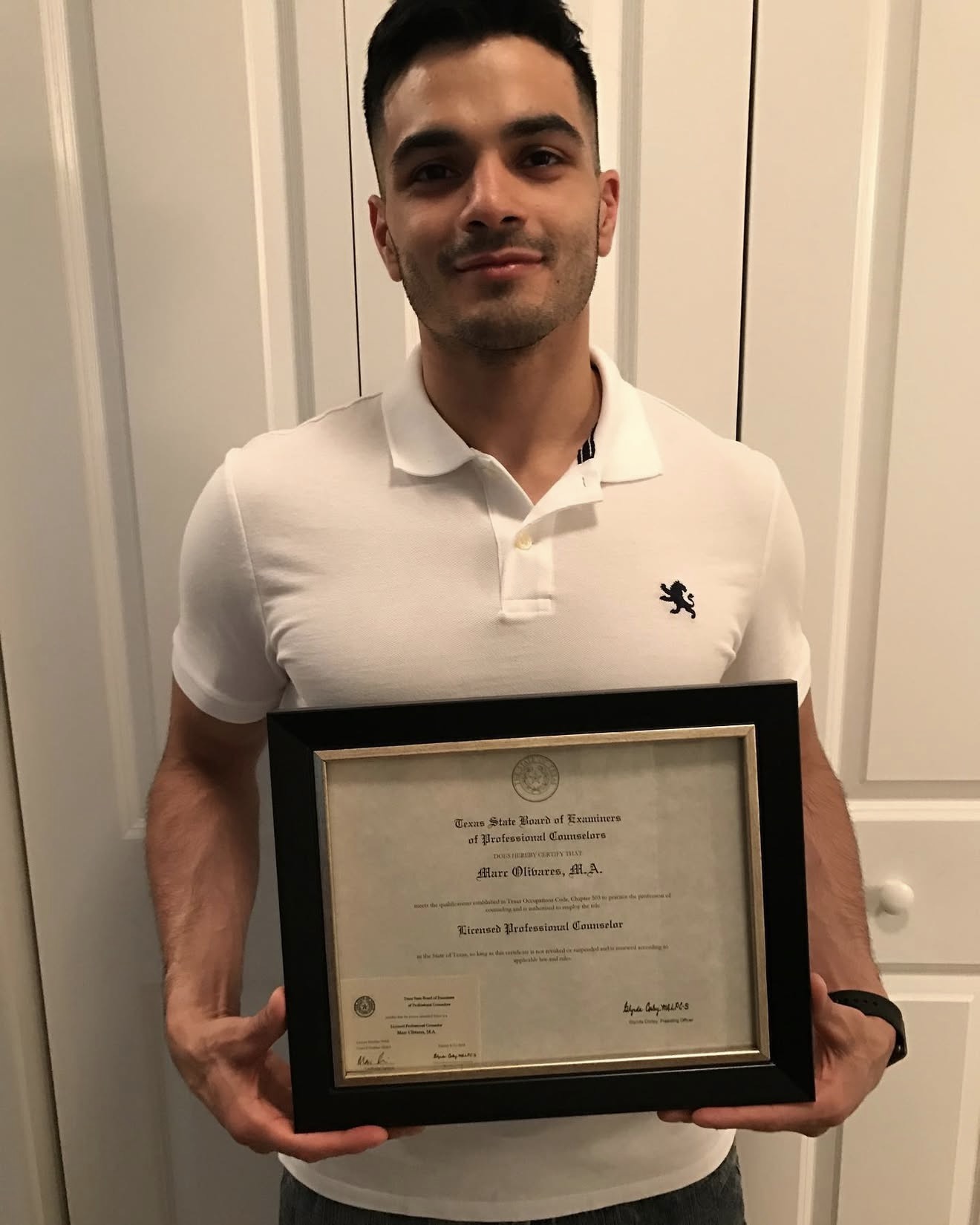




Today we’d like to introduce you to Marc Olivares.
Hi Marc, we’re thrilled to have a chance to learn your story today. So, before we get into specifics, maybe you can briefly walk us through how you got to where you are today?
I grew up in a South Texas border town. Both my parents were educators, and my dad also coached football for more than twenty years. He believed deeply in my ability to succeed academically. To him, that meant I could become whatever I set my mind to. I don’t think I fully understood what a gift that belief was until I lost him.
I was nineteen when my father died after a sixteen-month battle with an aggressive cancer. In the years that followed, I wanted to honor his confidence in me, but first I had to ask myself some challenging questions – Who was I? Who did I want to become?
Today, I’m a Licensed Professional Counselor and founder of Beautiful Mind Therapy. I also teach university psychology courses and help design and test new behavioral health care models. When people ask what drew me to this work, I think about that period of my life, but also about the curiosity that came before it.
As a child, I could spend hours with animal documentaries and books, and I loved visiting the San Antonio Zoo. I still remember an unreasonable number of animal facts. I was also fascinated by characters who could understand the mind and use that understanding to help others. I didn’t have the language for it then, but looking back, I can see an emerging interest in consciousness and the mind’s capacity for change.
Psychology was already a strong interest in college when a professor challenged me to push myself academically. That encouragement, alongside the questions I was asking after my father’s death, helped give my curiosity direction. I took my education more seriously, completed my undergraduate and graduate studies, and moved to Austin to complete my supervised clinical internship hours at a community mental health center.
After earning my professional license, I moved into leadership and managed programs serving children, adolescents, and adults. Alongside my professional growth, my personal experience in therapy was changing how I understood the work.
My therapist introduced me to interpersonal neurobiology, and I began reading Dan Siegel’s books. His ideas helped me understand my own experiences in a way that resonated deeply, and I wanted to bring that understanding into my work with clients.
Growing up around Texas football had taught me discipline, consistency, preparation, and evaluating what was working. Those qualities still organize much of my professional life. Through my own therapy, though, I began recognizing ways of approaching life that no longer served me. I became more comfortable with vulnerability and uncertainty and learned to approach myself with greater acceptance and compassion.
During the pandemic, I was overseeing the implementation of an innovative behavioral health care model for an Austin community mental health center while completing a second master’s degree focused on organizational and business psychology. The program helped me connect my values as a therapist with the practical decisions involved in building and operating a business. I began thinking about the people I hoped to reach, what I wanted them to experience in therapy, and how the practice itself could reflect those intentions.
That became the foundation for Beautiful Mind Therapy, where supporting people of color and the LGBTQ+ community is especially meaningful to me as a gay Mexican American man. My practice helps people make sense of their inner lives by exploring how their thoughts and feelings, the workings of their brain, and their relationships influence one another. My hope is that greater understanding helps people feel more connected to themselves and the people in their lives.
I started with a handful of clients. My first client session happened to fall on the anniversary of my father’s death, a coincidence that remains meaningful to me. The practice eventually grew into a full-time caseload across TX and DC. Over time, I discovered that I prefer combining a smaller, part-time practice with my work on broader systems of care. My work with care models brought me to Washington, where I continue designing and testing new approaches while seeing clients through Beautiful Mind Therapy. Today, I work with people individually and help shape how behavioral health care is delivered on a larger scale.
Would you say it’s been a smooth road, and if not what are some of the biggest challenges you’ve faced along the way?
Without a doubt, the hardest stretch was between graduating and getting my professional license. I had a master’s degree and was working toward my internship hours, but the pay was tough to live on.
I remember checking out at a grocery store after moving to Austin and realizing I didn’t have enough money to cover the total. I was living alone and had miscalculated my budget. I was embarrassed and a little frightened. In that moment, I worried I might not have enough money to eat.
I started driving for Uber and Lyft. Also, I had been teaching university classes in person before the move, so I reached out to former professors who knew me and my work. They helped me continue teaching online.
When I finally became licensed, I received a substantial raise. More than anything, I felt relief. I could keep doing the work I wanted to do with a little more room to breathe financially.
Alright, so let’s switch gears a bit and talk business. What should we know?
Beautiful Mind Therapy is a psychotherapy practice owned and operated by Marc Olivares, a Licensed Professional Counselor – Supervisor with more than a decade of experience. Offering virtual therapy throughout Texas and Washington, D.C., the practice specializes in men’s mental health, relationships, and LGBTQ+ concerns. The practice also supports people navigating anxiety, depression, trauma, and life transitions.
At Beautiful Mind Therapy, clients explore how their experiences have shaped the ways they see themselves and relate to others. This includes noticing thoughts, emotions, and physical reactions, and understanding how each can influence the others. Something that seems confusing in the moment may become more understandable when considered alongside a person’s history, relationships, and current circumstances.
That understanding can help initiate change. Clients learn to notice when familiar reactions arise, understand what those reactions may be communicating, and explore whether responding differently would better serve them. The work allows room to both accept their experience and practice something new, whether that means expressing a need, managing an overwhelming feeling, or approaching a difficult conversation with greater openness.
Sessions combine warmth and attentive listening with thoughtful questions, practical tools, and opportunities to try new ways of responding in the moment. Clients might practice staying present with a difficult feeling or expressing something they usually hold back. The aim is to help people feel more comfortable with themselves and better equipped to participate in their lives and relationships in ways that matter to them.
Beautiful Mind Therapy is proud of making psychotherapy accessible. Insurance participation, virtual sessions, and afternoon and evening appointments give clients more options for fitting therapy into their lives. The practice is also proud to offer representation and a sense of belonging for people of color and LGBTQ+ clients.
Can you share something surprising about yourself?
I’m fairly private, so this question took some thought. People who know me professionally might be surprised by how expressive I am. I can come across as composed and serious, but I like to make people laugh, swear more than I probably should, and get loud and excited when something interests me. I also have moments when I feel unsure of myself, even if I look calm. Being thoughtful about how I show up doesn’t mean I always have it all figured out.
Contact Info:
- Website: https://beautifulmindtherapyATX.com
- LinkedIn: https://linkedin.com/in/olivares-marc
- Other: https://www.psychologytoday.com/profile/916061