



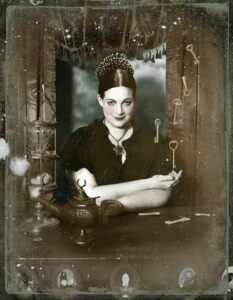
Today we’d like to introduce you to Beth Burns.
Hi Beth, we’re thrilled to have a chance to learn your story today. So, before we get into specifics, maybe you can briefly walk us through how you got to where you are today?
Some of my earliest memories are of tiny me pretending to be a theatre director. I’d give pages of scripts to my grandmother’s friends and make them read plays I had written in crayon. I followed that early love of theatre into college and on from there to Los Angeles, where I moved with the intent of acting, directing, and playwrighting on a larger scale.
In LA, I fell in love with improv and became a performer and teacher at the Groundlings Theatre where I worked for over ten years. Longing for home again, I headed back to Texas to raise my kiddo and find my next theatre adventure.
Settled back in Austin, I started to think about what kind of theatre I wanted to see but wasn’t readily available. I had always been fascinated by the idea of going back in time to see Shakespeare’s works as performed originally, and through my background as an actor/director/playwright/improvisor with strong affection for Early Modern scholarship, my own company, The Hidden Room Theatre was born.
The best part of it all is that my work here in Austin allows me to work with the most fascinating, exciting, empathetic, intelligent, kind people in the world. We strive to bring theatre that may seem lofty or difficult to everyone in a wildly accessible way and examine ourselves as a community through the ways in which we have historically told our own stories. As a bonus, it allows me to leverage all my bizarre cauldron of skills that I’ve developed over the years. I’m at my happiest inside The Hidden Room, and I am really looking forward to getting our actors and our audiences back in there as soon as we safely can. Until then, the Hidden Roomies and I still get together via Zoom when we can, sometimes trying out new plays I’m trying out, this time thankfully not in crayon.
We all face challenges, but looking back would you describe it as a relatively smooth road?
I tend to look at life as a series of challenges and solutions. I realized pretty early on that no one was going to do the hard work to produce the things I wanted to see and then hire me to direct it or act in it. If I wanted it done, I had to do it myself. Also, it’s not a big secret, but there’s actually not much money to be made in theatre. If you’re doing it, you’re doing it out of love and possibly insanity. But if you’re lucky (which I have been) you find group of like-minded lunatics who are down to create and play with you. There’s nothing like that feeling of making something different and wonderful and communal onstage that people are really connecting to, and it makes the inevitable bumps in the road to get there well worth it.
Appreciate you sharing that. What else should we know about what you do?
I like to think of The Hidden Room as a time machine, where we work with some of the world’s top scholars to recreate original playing practices for historically significant plays. We’ve toured the US and abroad, including stops at Shakespeare’s Globe Theatre, Oxford University, the British Library, and the Shakespeare Institute in Stratford-Upon- Avon, and we’ve been featured on NPR, BBC World News, London’s Channel 4, Time Magazine, American Theatre Magazine, and more. The company has been the subject of numerous scholarly papers and has accumulated over sixty awards for theatre in our ten years.
Is there anyone you’d like to thank or give credit to?
At the University of Houston, I was lucky enough to study Shakespeare with Dr. Sidney Berger, directing with Jose Quintero, and playwrighting with Edward Albee, with whom I had a particularly strong bond. Albee remained my mentor and friend after I graduated and encouraged my move to Los Angeles.
At the Groundlings, my teacher Michael McDonald (MadTV) was hilarious and inspirational and helped me to better understand the freedom and fun in creating strong characters and letting them do all the work.
I had another great stroke of luck when I met a remarkable actor named Peter Shorey from the Royal Shakespeare Company and The Globe. Shorey took time to work with me on my Shakespeare approach and completely changed my perspective. I stole everything I could from him. Soon after, actor and theatre professor Matt Radford offered more guidance and approach to Early Modern verse and prose, and that was invaluable.
The other actors and artists at the Hidden Room are my biggest heroes and inspirations.
It may sound a bit strange, but my favorite compliment that we get at the Hidden Room is “why did you update the play into modern language?” Of course – we absolutely didn’t. It’s all as it was written. It’s absolutely my work with all of these legends that helped shape this result of immediacy and fun, even in scripts that can look inscrutable on the page. I’m forever grateful to them all.
Contact Info:
- Email: beth@hiddenroomtheatre.com
- Website: www.hiddenroomtheatre.com
- Instagram: hiddenroomtheatre
- Facebook: @HiddenRoomTheatre
- Twitter: @thehiddenroom
- Other: https://vimeo.com/hiddenroomtheatre


Image Credits:
Darla Teagarden, Kimberley Mead, Pat Jarrett, Christopher Shea