


Today we’d like to introduce you to John Langmore.
Hi John, can you start by introducing yourself? We’d love to learn more about how you got to where you are today?
You could argue photography is in my blood. My father was a highly accomplished photographer best known for his work on the American cowboy published as a book in 1975. My mother started one of San Antonio’s most successful portrait studios which was later run by my brother and sister. In my family being a black sheep meant pursuing a professional career which I did for the early part of my life. It was the gift of a camera on my wedding day as my wife and I were relocating to Asia that ultimately derailed my intended career as a lawyer. Like most photographers, I started out photographing whatever was in front of me. My vacations slowly became more about subject matter than about enjoyment. Thank goodness Erika humored me. Then I started searching out venues to display that work – coffee shops, corporate lobbies, empty office spaces, anywhere with four walls. It was advice given at photo workshop with the Magnum photographer, David Alan Harvey, that led to my ultimate pursuit of long-term projects. I came home to Austin and began a project documenting the fast-fading African American and Mexican American communities of old East Austin. That work was published as the book, “Fault Lines”, in 2019.
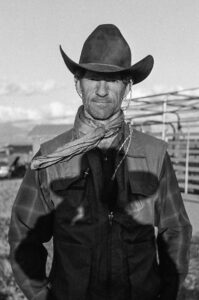
In 2012, I began a project documenting working cowboys across the American West. I was not only picking-up forty years onward where my father left off but was also returning to my own roots as a former cowboy. I spent summers from sixth grade through my first year of law school working on the same large ranches my father and I both photographed. “Open Range – America’s Big-Outfit Cowboy” was published in 2018. And as is so often the case, one thing led to another and I was approached by an Austin filmmaker, Bud Force, about collaborating on a documentary film on working cowboys. We concluded that four-year project in 2019 when the feature-length documentary film, “Cowboys”, premiered at the Austin Film Festival. I’m now continuing that never-ending pursuit of other long-term projects.
Would you say it’s been a smooth road, and if not what are some of the biggest challenges you’ve faced along the way?
Nothing in the arts is a smooth road! Aspiring photographers and filmmakers prepare yourself. Fortunately, the benefits of working on projects far outweighs the arduousness of the process. What’s most difficult is staying true to yourself and your own artistic vision. A few people knock it out of the park with their first project. That’s the rare exception. It shouldn’t be the benchmark for anyone chasing an artistic life. Artistic pursuits largely entail lots of rejection, bouts of self-doubt and endless advice to change your direction based on the current Zeitgeist. But staying true to your own vision is the only way to produce work transcending its time. Think of some of the greatest and most revered photobooks/projects – they were panned in their day with the photographers buying unsold copies back from the publisher (The Americans by Robert Frank or The Bikeriders by Danny Lyon, to name a few). But there’s something unique to artistic success that far exceeds the rewards of success in most professional pursuits. Just ask any musician, actor, artist, photographer, filmmaker, etc. It’s enough to keep you going.
Thanks for sharing that. So, maybe next you can tell us a bit more about your work?
For all the talk of artistic endeavors, I don’t really consider myself an artist. I think of myself as a documentary photographer out to tell a story. My overlap with the arts is merely that telling a visual story is most effective when it’s done artistically. You contemplate the subject matter in an entirely different way when you’re drawn to an image both for its content and its artistic merit. But in the end, it’s the story that matters to me. I’d like people to go through my books or watch my film reflecting on the lives of the people featured, not on my story as a photographer or filmmaker. But most important to me is having the subjects of my projects feel I’ve told their story with integrity and honesty. That seems the least I can do to respect how they let me enter their lives and the risk they take handing their story off to someone who intends to tell it to the world and who they might hardly know.
What matters most to you? Why?
Honesty in my work. It has the dual benefit of respecting the people I photograph as well as creating the greatest prospect of my work standing the test of time.
Contact Info:
- Email: johnlangmore@gmail.com
- Website: www.johnlangmorephotos.com
- Instagram: @johnlangmore
- Facebook: https://www.facebook.com/john.langmore.1/